
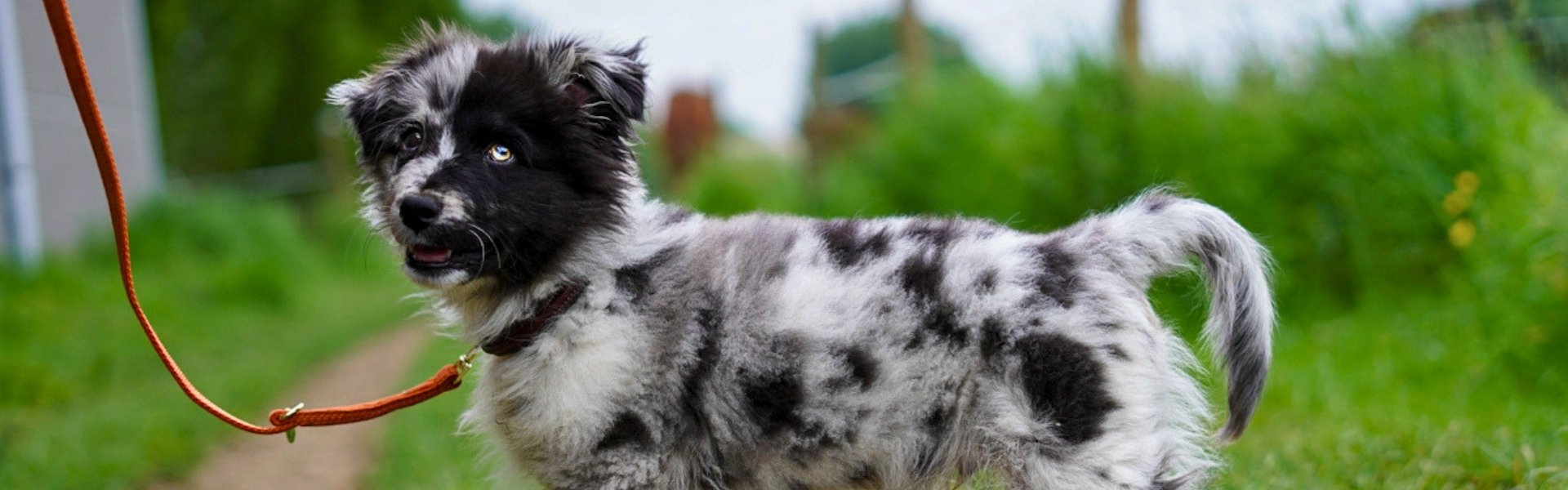
At Waf & Co, our passion for animals did not begin yesterday. Before devoting ourselves to our canine companions, we built our expertise in the world of high-level equestrian sport. In the stables, we learned a golden rule: ill-fitting tack on a horse alters its movement, creates chronic pain and damages the bond with its rider. That absolute requirement for comfort, biomechanics and safety is what we apply today to your dogs' equipment.
Your dog's collar is not just a strip of webbing. It is the direct physical point of contact between you and your dog. A careless choice — based on colour alone — exposes your companion to silent injuries. Through this guide, created by our team of enthusiasts, discover how to combine comfort, durability and elegance by choosing the collar perfectly suited to your dog's breed and needs.
In this guide
- 1. The anatomy of the neck: why collar mistakes are unforgiving
- 2. Leather, rope and fabric: breakdown and comparison
- 3. Choosing the size and width to match your dog's build
- 4. Expert breed-by-breed advice: precise biomechanical needs
- 5. Visibility and safety: anticipating extreme conditions
- 6. Tutorial: measuring and fitting the collar properly
1. The anatomy of the neck: why collar mistakes are unforgiving
Before browsing the catalogues of major brands such as Shires or Silver Crown, it is vital to understand what lies beneath your dog's skin. The neck is an extremely complex anatomical crossroads, crossed by vital, life-sustaining structures. When a dog pulls on its leash, the kinetic energy is transmitted entirely to the few square centimetres covered by the collar.
- The trachea and oesophagus: These are very flexible tubes located on the underside of the neck. Constant pressure (for example from a collar that is far too thin) crushes the cartilage rings of the trachea. Over the long term, this causes chronic inflammation, a characteristic "honking" cough, and even irreversible tracheal collapse.
- The thyroid gland: Located very close to the surface, it regulates the animal's overall metabolism. Repeated impacts and friction from a rigid collar can trigger inflammation (thyroiditis) and disrupt its endocrine system.
- The neurological and vascular network: A collar that chokes blocks venous return from the jugular veins. Veterinary clinical studies have shown that extreme tension on a collar significantly increases intraocular pressure, which is very dangerous for breeds prone to glaucoma.
The ideal collar must therefore obey a simple physical rule: dissipate energy. It must be wide enough to spread pressure across several cervical vertebrae, and made from a material able to follow movement without creating a hard pressure point.
2. Leather, rope and fabric: breakdown and comparison
There is no single "best" material in absolute terms. There are only materials suited to a specific use. The working gear of a hunting dog in the rain has nothing in common with that of a companion dog in an urban setting.
The nobility of saddlery: leather
Drawing directly on fine equestrian bridle-making (in the spirit of the Silver Crown collections), leather dog collars remain the benchmark for discerning owners. A high-quality leather needs a short breaking-in period, but over the days it softens and moulds perfectly to the animal's shape. It is breathable, hard-wearing and hypoallergenic.
Technical ruggedness: rope
Inspired by mountaineering, rope dog collars are remarkably effective. Their main asset lies in their round shape. On a long-haired dog, a traditional flat collar tends to crush the coat. Braided rope slides freely between the hairs without creating painful tangles. It is a rot-proof and extremely resistant material.
Versatility and practicality: fabric
Technical fabrics offer unbeatable lightness. That is why fabric dog collars, often woven from nylon or lined with microfibre (like Kentucky's Corduroy models), are very popular. They dry quickly and adapt perfectly to urban daily life or to more sporty outings.
| Material | Main advantages | Recommended use | Care |
|---|---|---|---|
| Leather | Extreme durability, moulds to the anatomy, hypoallergenic, elegance. | Adult dogs, daily use, dogs with sensitive skin. | Regular (glycerine soap and oiling). |
| Braided rope | Doesn't pull out hair, high resistance to traction. | Long-haired dogs (Husky, Spitz, Shepherd), hikes. | Low (machine washable, cold). |
| Fabric (nylon / velvet) | Absolute lightness, quick drying, wide choice of colours. | Growing puppies, small builds, urban use. | Low (machine washable). |
3. Choosing the size and width to match your dog's build
The strength of the materials and the width of the strap must be strictly correlated to your dog's weight.
A common mistake with small breeds is to burden them with gear that is too heavy. A solid steel buckle on a small neck causes continuous muscle fatigue. Small dog collars require miniaturised hardware and great fineness (such as a 10 mm rope or lambskin leather) so as never to hinder their natural head carriage.
Conversely, equipment for large, powerful dogs tolerates no weakness. Large dog collars must feature a wide strap (at least 3 to 5 cm) in order to spread the bearing surface in the event of strong tension. The attachment rings must be welded and the stitching reinforced to prevent any accidental opening if the dog lunges suddenly.
4. Expert breed-by-breed advice: precise biomechanical needs
Equipping a dog means above all respecting its genetics. We have segmented our recommendations to address the anatomical predispositions of the most demanding breeds.
Sighthounds and long necks
The sighthound has a very high head carriage and a slender neck, often wider at the base than at the head. A classic straight collar would slip off immediately. Their build calls for a traditional flared shape (wider in the centre) and padded lining to protect their sensitive skin without allowing them to escape.
Working dogs and molossers
The German Shepherd, the Malinois and the American Staff share an over-developed neck musculature. For these breeds, mechanical safety is the number one criterion. Opt for ultra-robust models in thick leather or multi-layer ballistic nylon:
Water dogs and Nordic primitives
An unconditional water lover, the Labrador needs gear that dries quickly. A thick conventional fabric will stay damp for hours, encouraging the growth of bacteria on its skin. That is why Labrador dog collars should ideally be chosen in fine technical fabric or rot-proof rope.
For its part, the Siberian Husky has a very dense double coat. The regular friction of a flat, rigid collar will "break" its guard hair. Husky dog collars are best when round (like rope) or very soft and padded, so they glide over the coat without flattening it.
Brachycephalics and miniatures
The French Bulldog, because of its short airways (brachycephalic syndrome), must not undergo any concentrated pressure on the throat. French Bulldog dog collars should be as wide and flat as possible. As for the Chihuahua, its cervical area is so delicate that Chihuahua dog collars should serve as a light support for identification, with traction ideally being avoided.
5. Visibility and safety: anticipating extreme conditions
Modern canine equipment now incorporates passive and active safety very elegantly. Walking your dog along a road, or letting it off the leash at the edge of a forest during hunting season, calls for vital anticipation so that it can be seen by drivers and others out in nature.
Reflective technology (often via micro-prisms woven into nylon or rope) returns the light from headlights without spoiling the design of the accessory during the day. That is the great advantage of reflective dog collars. For complete autonomy and active 360-degree light visibility up to 500 metres in total darkness, however, it is essential to complete the equipment with light-up dog collars fitted with rechargeable LEDs.
6. Tutorial: measuring and fitting the collar properly
Even the finest saddlery equipment in the world becomes ineffective, even dangerous, if it is poorly positioned. A fit that is too loose will let the dog back out of it (a panicked backward movement). Too tight, and it becomes a constant source of breathing discomfort.
- Step 1: the right tool. Always use a soft seamstress's tape measure. Never measure an old collar laid flat on a table to work out the size: the thickness of the material would completely distort the true internal circumference.
- Step 2: the measuring point. Place the tape around the base of your dog's neck, where the collar naturally rests (just above the shoulder blades). Note: for very hairy dogs, be sure to part the undercoat so the tape is in direct contact with the skin.
- Step 3: the golden two-finger rule. Once the collar is on and buckled, you should be able to slide exactly two fingers (index and middle finger), laid flat, between the collar and the dog's skin. This space ensures the animal can pant freely, bark and lower its head to sniff the ground without feeling any choking.
This expert guide was crafted with passion by the Waf & Co team. Every outing should be a shared pleasure, and choosing the right equipment is the first step towards that harmony. If you are still hesitating over the choice of a material or a tricky size, our team remains entirely at your disposal.