
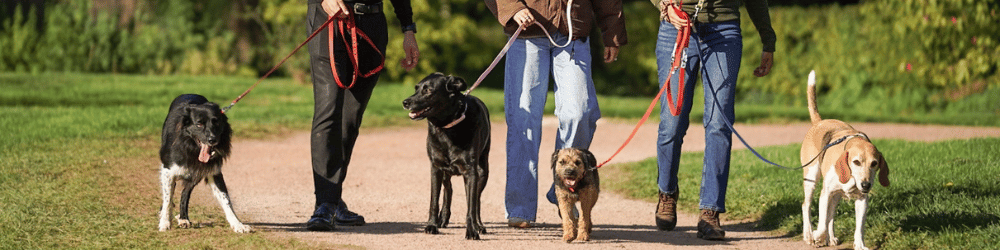
A collar is one of the accessories a dog may wear every day. However, with so many different materials, widths, sizes and fastening systems available, it is not always easy to know which collar to choose for your dog.
A good collar should above all suit your dog's body shape, be comfortable and match how you intend to use it. A dog that regularly goes swimming, for example, will not have the same needs as a dog that mainly wears a collar for walks in town.
In this guide, we help you identify the main criteria to consider when choosing a suitable collar for your dog, before introducing the solutions we have developed at Waf & Co.
In this guide
- Why is it important to choose the right collar for your dog?
- How to choose a suitable collar for your dog
- Which material should you choose for a dog collar?
- Waf & Co collars: practical, waterproof and two-tone
- Which leash should you choose with your dog's collar?
- Collar or harness: which should you choose for your dog?
- How to clean a dog collar
- What is ultimately the best collar for your dog?
Why is it important to choose the right collar for your dog?
The collar is in direct contact with your dog's neck and may be worn for several hours a day. Its size, weight, width and material therefore matter.
A collar that is too tight can be uncomfortable, while one that is too loose may move excessively or, depending on your dog's body shape, slip over their head.
The choice also depends on how the collar will be used. Some dogs mainly wear their collar to carry their identification tag, while others are also attached to it during walks.
Collars and walks: consider your dog's behaviour
If your dog pulls strongly on the leash or has particular sensitivity around the neck or airways, a collar is not necessarily the most suitable equipment for attaching them during walks. Depending on the dog and the situation, a correctly fitted harness may be preferable.
How to choose a suitable collar for your dog
There is no single ideal model for every dog. Breed or weight can provide some guidance, but your dog's actual body shape and how the collar will be used remain the best criteria for choosing.
Choosing the right collar size
The first step is to measure your dog's neck circumference. Use a flexible tape measure and position it where the collar will naturally sit.
The collar should fit closely enough that it cannot easily slip over the head, while still allowing your dog to move comfortably. Once adjusted, check the fit while your dog is standing and moving.
Measure your dog rather than their old collar
When choosing a size, take the measurement directly around your dog's neck. Two dogs of the same breed or weight can have very different neck circumferences. Remember to check the fit regularly for a growing puppy or after a significant change in weight.
Choosing a width suited to your dog's body shape
The width of the collar should also be appropriate for your dog's size and body shape. A very wide collar can be bulky on a small neck, while a very narrow model is not necessarily suitable for a powerful or large dog.
You should also take into account the length of the neck, the coat and how the collar sits when your dog moves.
Taking its intended use into account
Before choosing, consider the situations in which your dog will wear their collar.
- Do they wear it every day?
- Is it used for walks on the leash?
- Does your dog enjoy swimming?
- Do you often walk in the rain or on muddy paths?
- Does their coat easily retain moisture and dirt around the collar?
- Are you primarily looking for an accessory that is easy to clean?
These questions can help determine which collar material will be the most practical for everyday use.
Which material should you choose for a dog collar?
Leather, textile or coated synthetic material: each option has its advantages and constraints. The right choice depends mainly on your everyday life and your dog's.
| Material | Advantages | Things to consider |
|---|---|---|
| Leather | Traditional appearance, a material that develops a patina over time | Requires appropriate care and is less suited to repeated exposure to water |
| Textile | Often lightweight, flexible and available in many styles | May absorb water, retain dirt and take longer to dry |
| Coated synthetic webbing | Waterproof, easy to clean and suitable for regular outdoor use | Its feel and appearance are similar to BioThane® |
Waf & Co collars: practical, waterproof and two-tone
At Waf & Co, we wanted to create a collar that could genuinely be used every day: in the rain, during walks, by the water or simply when our dog decides that a muddy puddle absolutely has to be explored.
We therefore chose waterproof, easy-to-clean coated synthetic webbing. Our collars combine two layers of webbing in different colours to create the range's distinctive two-tone design. They have a 1.8 cm wide base, 5 adjustment holes and stainless steel hardware (buckle, rivets and D-ring). The different components are assembled by hand in France.
Are our collars made from BioThane®?
No. The material used for our range is coated synthetic webbing, whose appearance and some practical benefits are similar to those of BioThane®. However, it is not BioThane®, and we prefer to be completely transparent about this difference.
A material chosen for real life with a dog
Unlike some textile or leather materials, the coated synthetic webbing used for Waf & Co collars does not absorb water. After a wet or muddy walk, it can easily be cleaned and wiped dry. This also makes it easier to keep the collar clean despite regular use. It is therefore particularly practical for:
- dogs that enjoy swimming;
- regular walks in the forest or countryside;
- walks in wet weather;
- dogs that enjoy exploring puddles and muddy paths;
- owners simply looking for a collar that is easy to care for every day.
Waf & Co Rive collars are a practical and stylish accessory, chosen first and foremost with everyday use with your dog in mind.
Why two-tone collars?
Because practical does not necessarily mean basic. We wanted colour to be an integral part of the range's identity. Our collars therefore combine two different shades. Sky blue and brown, navy and khaki, burgundy and red, black and khaki, orange and brown, pink and orange, or red and sky blue: each combination creates a different look while retaining the same design.
Which leash should you choose with your dog's collar?
Once you have chosen the collar, there is still the question of the leash. Here again, the best model depends above all on how you like to walk your dog. At Waf & Co, our leashes use the same coated synthetic webbing measuring 1.8 cm wide, the same stainless steel hardware and the same two-tone colour combinations as the rest of the range.
The standard leash for everyday walks
The standard leash measures approximately 1.30 m, including the snap hook. It provides a simple configuration for everyday walks. It can be matched with the collar to create a coordinated set.
The multi-position leash for greater versatility
For greater versatility, the multi-position leash has several attachment points that allow you to change its configuration. It measures 2.50 m when used with a handle and approximately 1.40 m when worn cross-body. Cross-body mode can be particularly practical when you want to keep your hands freer. However, it should only be used in a suitable situation and with a dog whose behaviour on the leash allows this type of use.
| Model | Length | Use |
|---|---|---|
| Standard leash | Approximately 1.30 m | Everyday walks and straightforward handling |
| Multi-position leash - handle mode | 2.50 m | Greater length during walks |
| Multi-position leash - cross-body mode | Approximately 1.40 m | Hands-free use when suitable for the situation and the dog |
👉 Discover Waf & Co dog leashes
Collar or harness: which should you choose for your dog?
Collars and harnesses do not necessarily meet exactly the same needs, and there is no need to choose one over the other permanently.
A collar can be practical for everyday use, particularly for carrying your dog's identification information and for walks when they walk comfortably on the leash. In other situations, a harness may be more appropriate. This is particularly worth considering when your dog pulls strongly on the leash or when their body shape, sensitivity or the activity involved makes pressure around the neck undesirable.
The most important thing is to choose equipment that is correctly fitted and suited to your dog's body shape and how it will be used.
How to clean a dog collar
Care depends above all on the material. It is therefore important to follow the recommendations specific to the product.
With our Waf & Co collars and leashes, care is particularly simple. After a muddy walk, remove any dirt with water and, if necessary, clean gently. Then wipe the accessory before storing it. After swimming in the sea or significant exposure to sand, remember to rinse the accessory with clean water to remove any residue.
Use cleaning as an opportunity to check the collar
Regularly check the overall condition of the collar and leash: webbing, buckle, rivets, ring and snap hook. If any component shows significant wear or damage that could compromise its strength, replace the accessory before the next use.
What is ultimately the best collar for your dog?
Your dog's body shape, behaviour on walks, environment and your activities should guide your choice. The best collar is therefore above all the one that suits your dog and your everyday life together.
This is the philosophy behind the Waf & Co range: practical, easy-to-use, matchy-matchy two-tone collars and leashes, assembled in France and designed to accompany everyday adventures as well as slightly more eventful outings.